2026 Stormwater Victoria Awards
Congratulations to the winners of the 2026 Awards for Excellence
The Awards Ceremony took place at Mantra Lorne on Tuesday, 2 June 2026 with over 200 people to celebrate the outstanding projects, people and organisations making a significant contribution to stormwater management and integrated water practices across Victoria. See below full list of winners:
Excellence in Asset Management
Winner
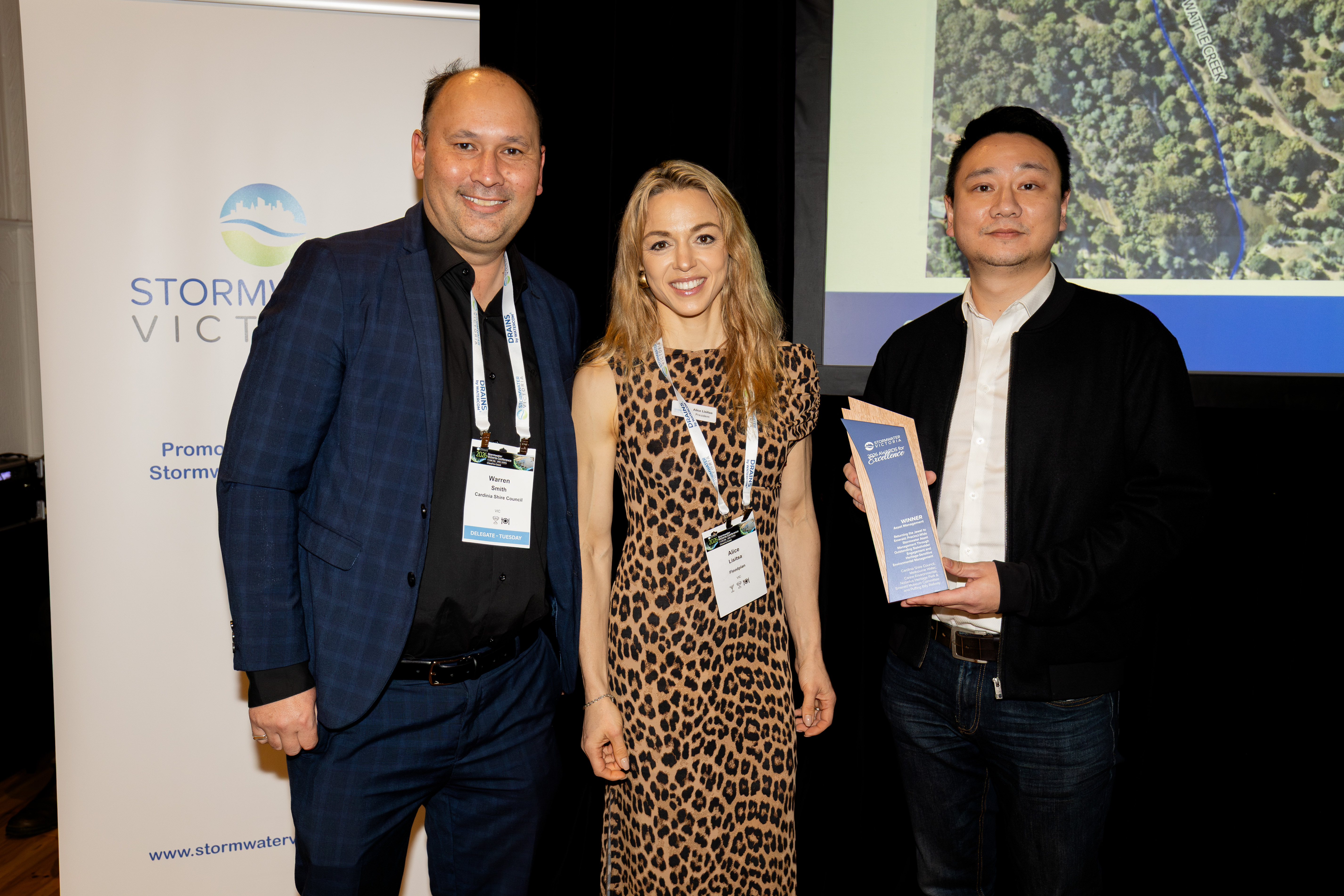
Returning the Jewel to Emerald: Precinct‑Wide Stormwater Asset Management Through Outstanding Stakeholder Engagement and Heritage‑Sensitive Environmental Management
Cardinia Shire Council
Project Overview: This precinct-scale program addressed long‑standing headwater erosion and pollutant mobilisation issues within an environmentally and culturally significant landscape. Delivering three interrelated projects within a precinct affected by a Vegetation Protection Overlay, Heritage Overlay and Significant Landscape Overlay, and supported by strong community stewardship through multiple volunteer groups and committees, required a highly considered approach to ensure all works respected the environmental and cultural significance of Emerald Lake Park and Nobelius Heritage Park.
Each project required tailored environmental management, including flora and fauna assessments, conservation planning, a robust communications plan and construction methodologies designed to minimise disturbance within this highly visited landscape. Gaining planning approval under the Heritage Overlay meant demonstrating that modern engineering and heritage protection are not opposing forces. We turned this challenge into an opportunity to showcase artfully delivered solutions that strengthened the precinct’s historic landscape.
Strong collaboration was essential to shaping the scope and delivery of the works, improving stakeholder satisfaction and avoiding budget creep. Melbourne Water provided funding and technical inputs, while coordination with internal teams, heritage planners, environmental specialists and external stakeholders, including Puffing Billy Railway, community groups and the parkrun organiser, ensured safe access, minimal visitor disruption and compliance with environmental and heritage requirements.
"This multifaceted project demonstrated a deep understanding of the role each water sensitive asset provided and showcases innovative engineering to repurpose those assets to meet broader objectives to achieve long term environmental benefits".
Excellence in Integrated Stormwater Design
Nominees
K Road Cliffs Masterplan Implementation Project – Engeny Australia, Wyndham City Council, and Urban Initiatives - Highly Commended
Bradmill Development – Stantec Australia
Alira Waterways & Estate – KLM Spatial and Stormy Water Solutions
Milan Drive, Integrated Stormwater and Public open space project, Irymple - Mildura Rural City Council
Excellence in Integrated Stormwater Design
Winner
Alira Waterways & Estate
KLM Spatial and Stormy Water Solutions
Project Overview: Alira is a landmark development which has transformed one of Melbourne’s most complex parcels into a vibrant community. Located in a natural flood plain by the Hallam Valley Contour Drain levee, a syphon under this major drain is the only outfall. Long considered “undevelopable” the land provided informal flood storage behind the levee, attracting antisocial behaviour and illegal dumping despite surrounding thriving residential growth.
KLM Spatial, Stormy Water Solutions, Moremac, Melbourne Water, City of Casey and a consortium of landowners worked collaboratively on the project for well over a decade. Through a pioneering regional stormwater strategy, this “undevelopable” land has transformed into a multi award winning neighbourhood, winning both the UDIA Victoria and National awards for excellence for Residential Subdivision in 2025/2026 respectively.
The end result is a series of four interconnected and ecologically rich wetlands, operating as a single treatment and flood storage system, at the centre of 770 new homes. Amongst a raft of incredible outcomes, the stormwater solution exceeded best practice water quality outcomes for 508Ha of previously untreated external catchments. The project has also successfully restored natural waterway and floodplain habitat values, and created high value recreational corridors linking existing floodplain developments in the surrounding area.
"Alira represents an exceptional example of integrated stormwater design that facilitated a previously undevelopable area, where complex flood, water quality, ecological and community objectives have been resolved through genuine design and integration of non-standard solutions at both project and catchment scale, supported by rare long-term collaboration and delivery of enduring, resilient public infrastructure".
Excellence in Policy and Education
Nominees
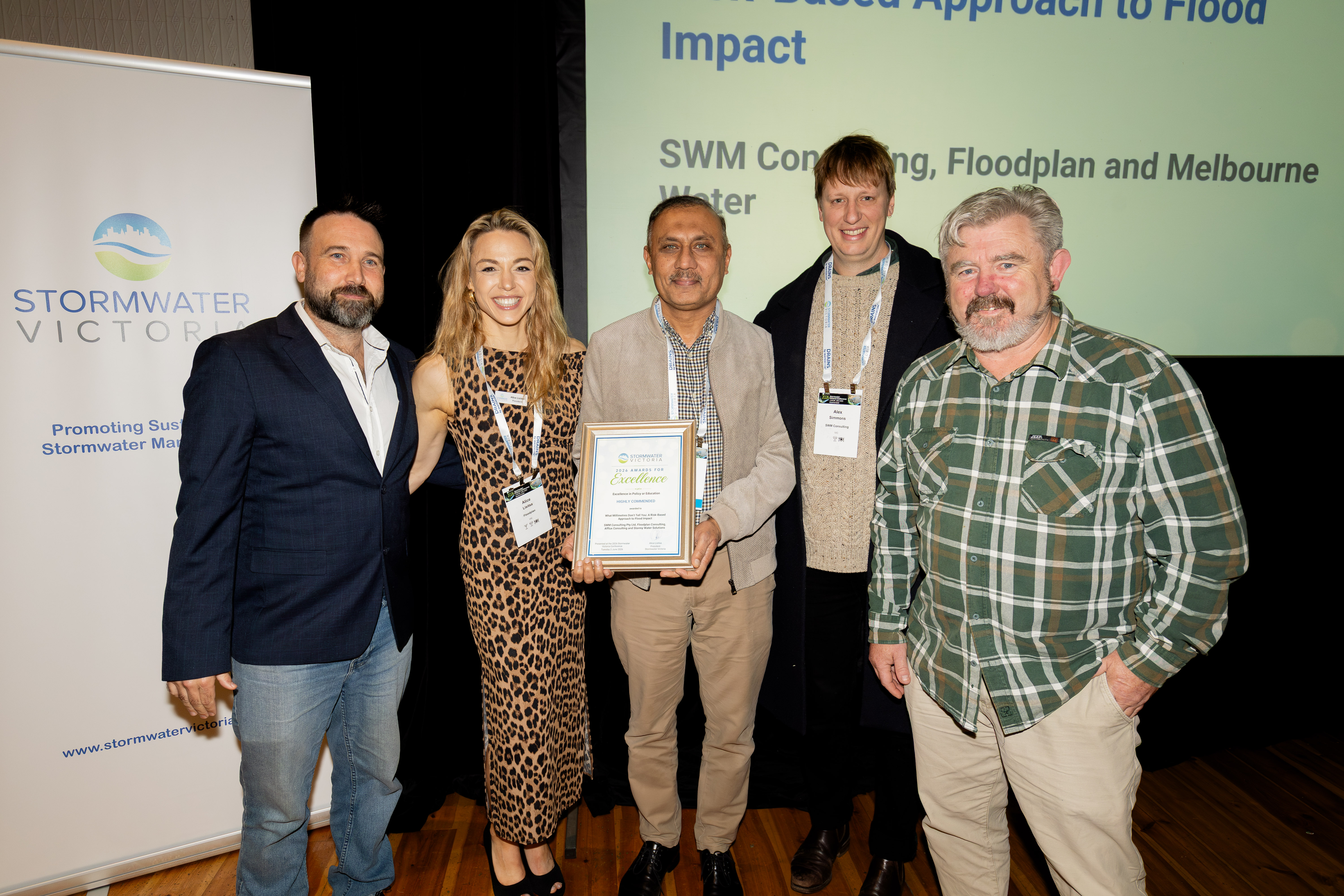
What Millimetres Don’t Tell You: A Risk-Based Approach to Flood Impact – SWM Consulting, Floodplan and Melbourne Water - Highly Commended
From Consultation to Governance: A Framework for Embedding Community Voice in Stormwater Decision-Making – Rain Consulting and Yarra Ranges Council
Understanding water across Wurundjeri Country – Arup and Wurundjeri Woi Wurrung Cultural Heritage Association
Excellence in Policy and Education
Winner
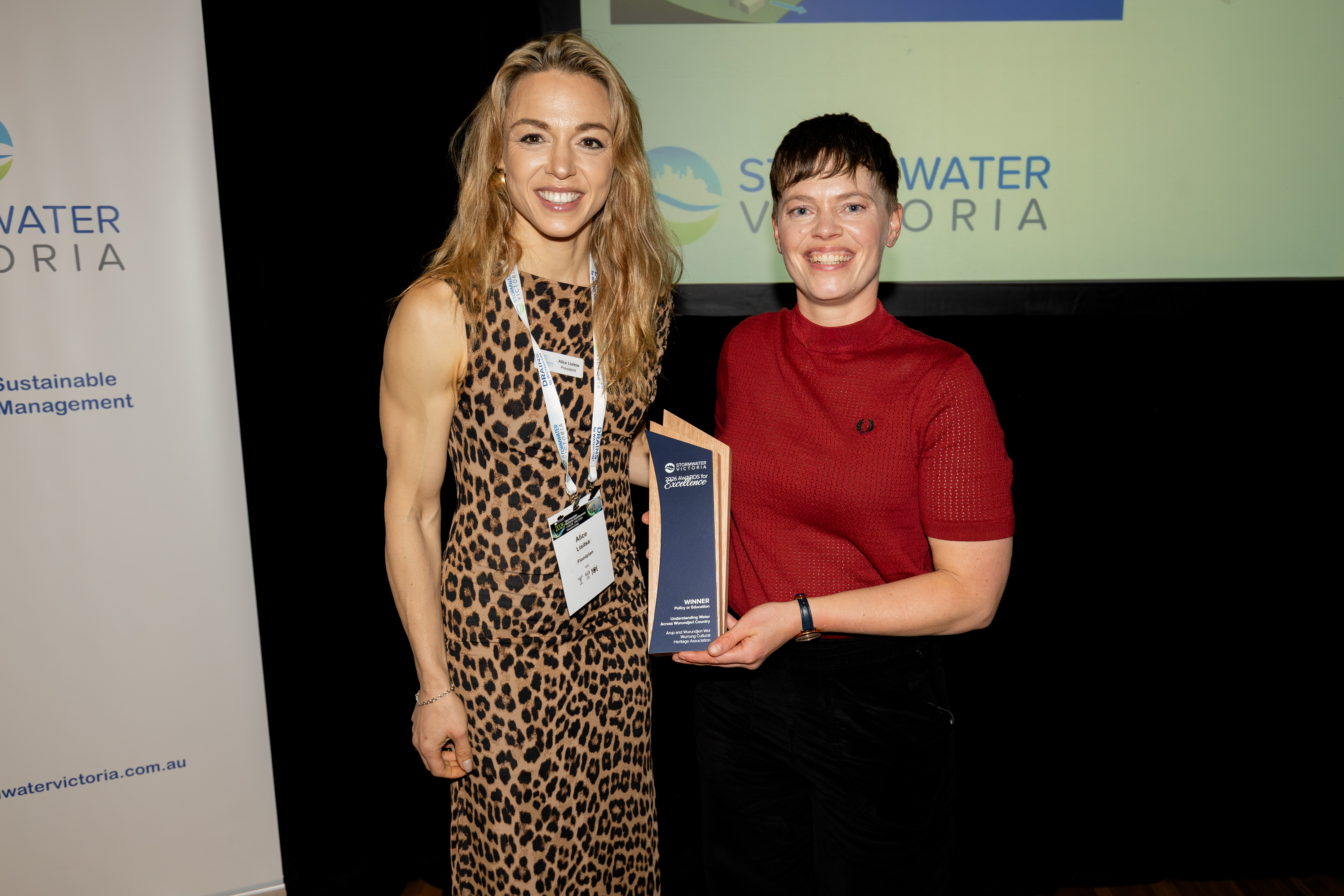
Understanding water across Wurundjeri Country
Arup and Wurundjeri Woi Wurrung Cultural Heritage Association
Project Overview: When decisions and activities have the potential to impact water within Wurundjeri Woi-wurrung Country, the WWCHAC work with other stakeholders to make decisions. In practical terms, this can mean that WWCHAC are asked to contribute to a wide number and range of projects and need access to area-specific data and information about water on country to understand the full context.
Wurundjeri Woi Wurrung Cultural Heritage Aboriginal Corporation (WWCHAC) and Arup collaborated to develop a data visualisation tool for understanding water on Wurundjeri Country. The tool, created through a co-design approach, integrates hydrological data, ecological indicators, water supply and use data, waterway catchments and water infrastructure locations. It aims to support WWCHAC in advocating for the health of Country and informing decision-making by providing a holistic view of water on Country from a First Nations perspective.
"This project clearly responds to the need for the Wurundjeri Woi Wurrung Cultural Heritage Association to have access to better water literacy and cultural framing within stormwater management and responds by establishing a Country centred resource for understanding water. It facilitates uptake of stormwater principles by reframing them within an interconnected First Nations narrative, strengthening conceptual understanding and informing better decision-making, rather than prescribing technical solutions".
Excellence in Research and Innovation
Nominees
Harnessing excess stormwater for distributed environmental flows – Streamology
Smarter Thresholds: Bringing Risk-Based Thinking to Flood Impact – SWM Consulting, Floodplan and Melbourne Water
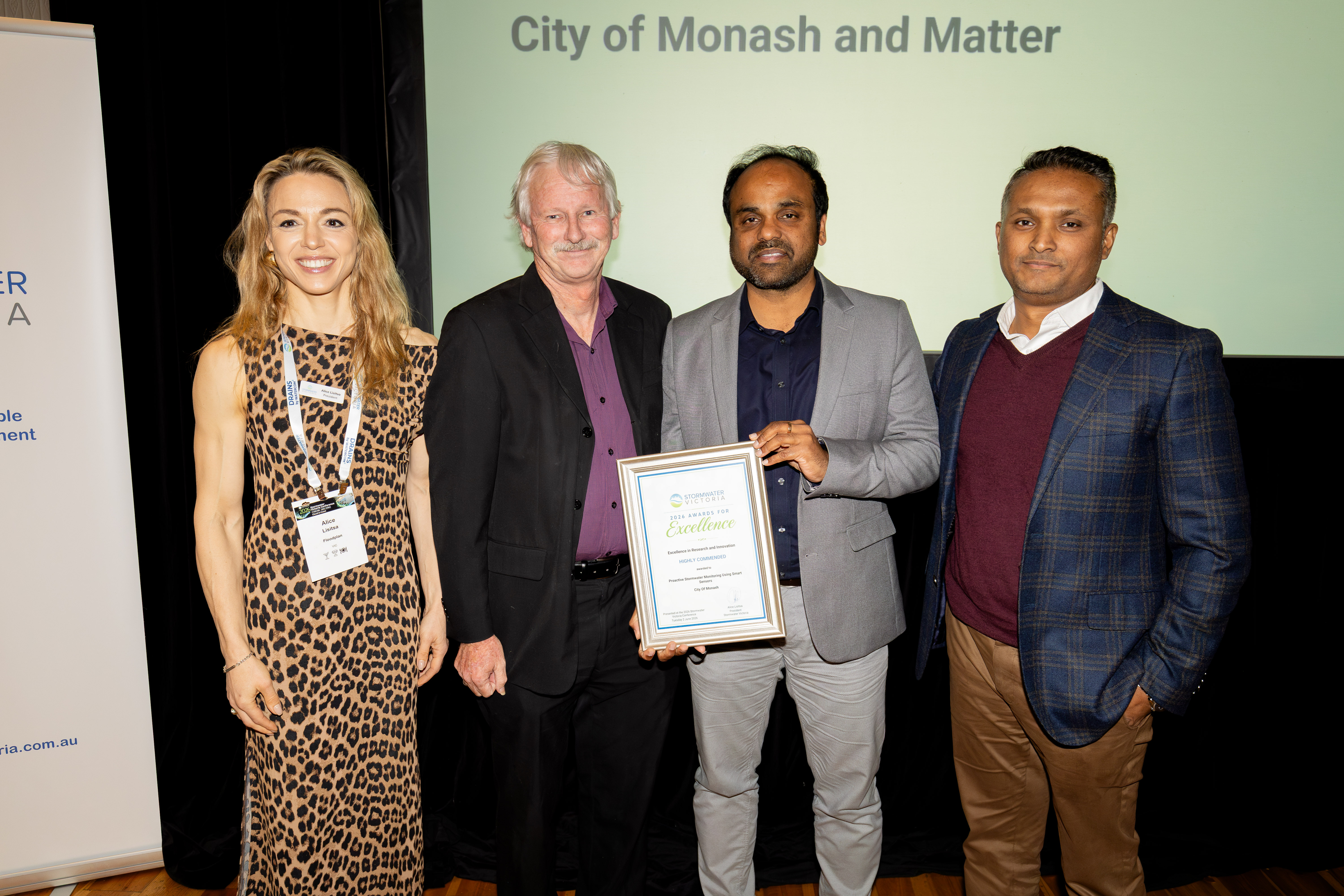
Proactive Stormwater Monitoring Using Smart Sensors – City of Monash and Matter - Highly Commended
Excellence in Research and Innovation
Winner
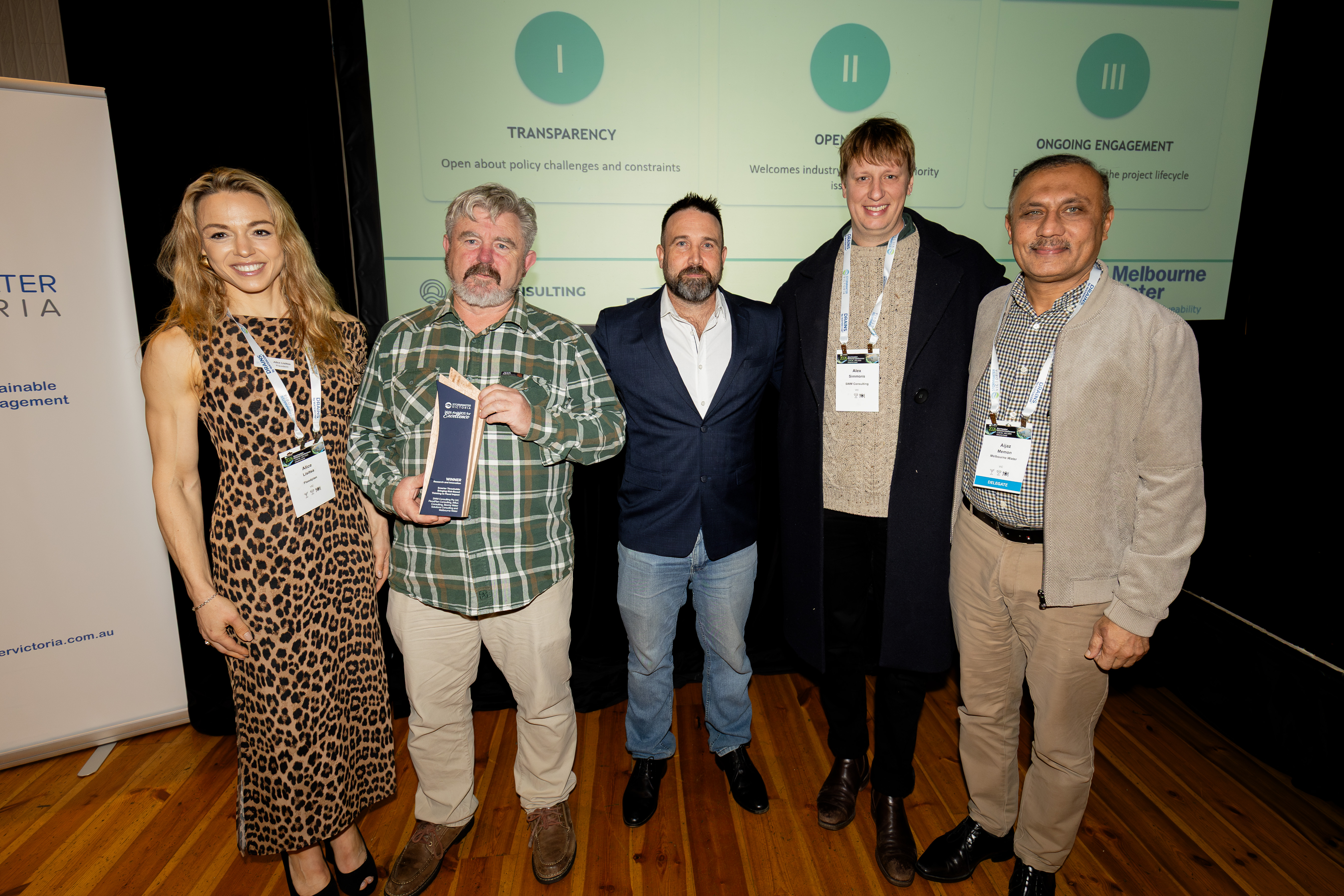
Smarter Thresholds: Bringing Risk-Based Thinking to Flood Impact
SWM Consulting, Floodplan and Melbourne Water
Project Overview: As the designated floodplain manager for the Port Phillip and Westernport regions, Melbourne Water plays a critical role in managing flood risks and ensuring that development does not adversely affect flood behaviour, property or community safety.
The Flood Impact (Afflux) Practice Note has been developed to provide clear and practical guidance on managing offsite flood level impacts for proposed developments, where zero-afflux cannot be achieved, by using a risk-based flood impact assessment framework. The risk-based approach to floodplain development impact assessment was established in collaboration with industry, via the Urban Planning and Development Strategic Collaboration Group (UPD SCG) technical working group. The UPD SCG is a technical working group of specialist flood engineers from independent consultancies facilitated by Melbourne Water, established to progress water cycle related urban planning and development challenges by collaborating with state government stakeholders and industry groups on measurable actions that improve policy and deliver outcomes.
The Flood Impact (Afflux) Practice Note provides clear guidance to assess flood impacts under a risk-based framework. The DEECA Guidelines for Development in Flood Affected Areas (2019) require that development cause no detrimental impact to nearby properties, and acknowledge that floodplain managers have discretion to vary their approach. In practice, however, no methodology existed for exercising that discretion.
This project provides that missing methodology. Developed by a technical working group of flood engineers from four independent consultancies, the framework introduces a five-step assessment process with five risk tiers (Extreme to Very Low), each linking allowable impact to actual consequences – land use, existing conditions, hazard and vulnerability. It recognises that flood impact is more than just a change in water level, and that effective floodplain management requires nuance, not a one size fits all approach. The staged implementation of the Practice Note focused on testing an early version of the Practice Note on 15 urban development projects and state-led initiatives to identify and address any gaps and ambiguities, increased the confidence in the framework and its applicability, and development further technical guidance and an approach for managing cumulative impacts. The project aligns with Melbourne Water’s Housing Statement Roadmap by introducing a risk-based approach that balances flood risk and urban development needs, providing clearer and more proportionate guidance for assessing minor flood impacts in low risk situations and this risk based approach ensures that developments cause “no detrimental impacts to nearby properties, particularly properties downstream” in line with the key principles in the DEECA Guideline.
"This project represents a clear step-change in floodplain management practice in Victoria. It identifies a long-standing gap between hydraulic model outputs and risk methodologies in Melbourne Metro area, and provides a robust, practical and defensible solution that is already embedded in practice. The combination of strong technical grounding, significant levels of collaboration, immediate uptake, and commitment to review of outcomes places this work firmly at the excellent end of the criteria for applied Research and Innovation".
Excellence in Strategic or Master Planning
Nominees
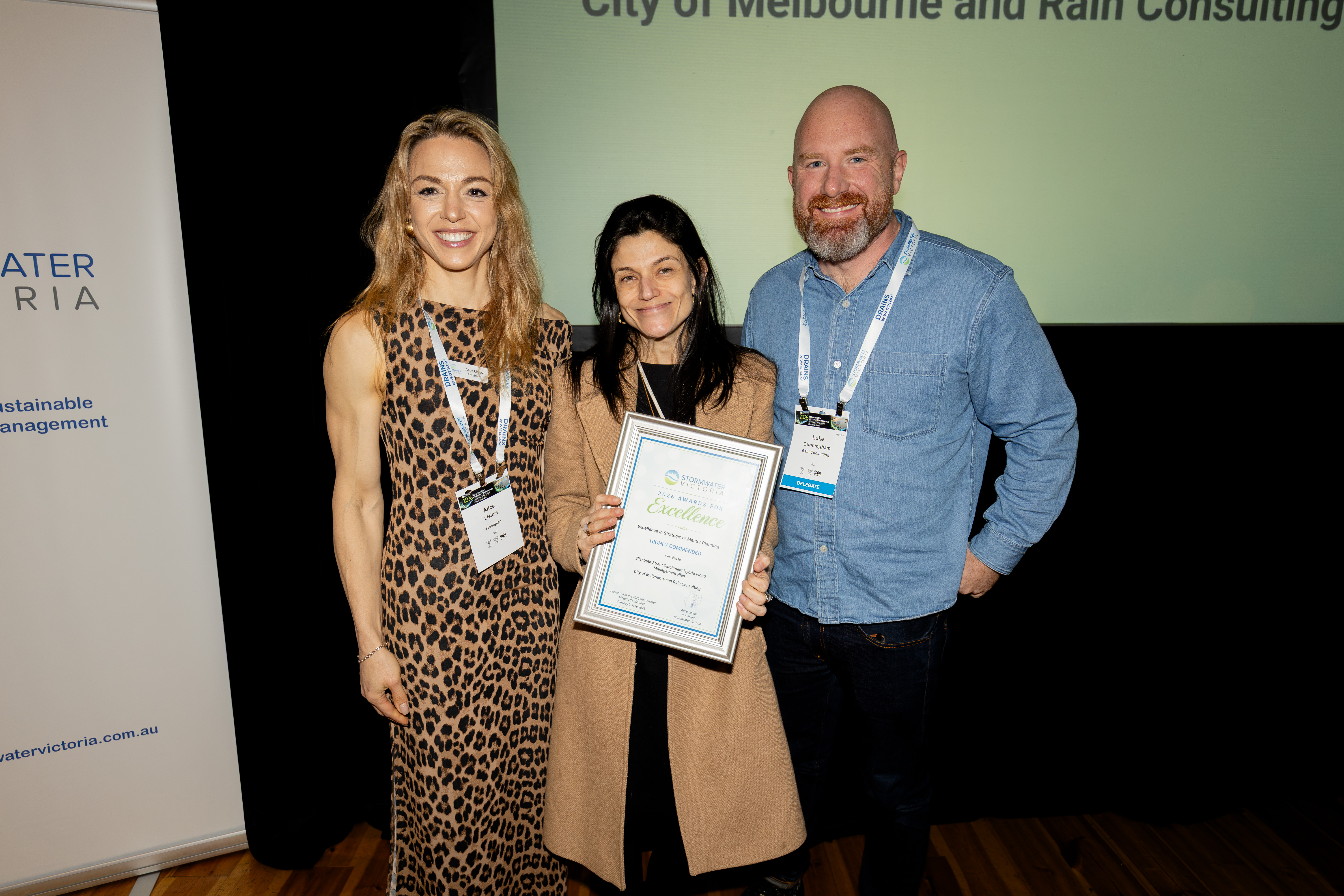
Elizabeth Street Catchment Hybrid Flood Management Plan – City of Melbourne and Rain Consulting - Highly Commended
Adaptive capacity modelling of the public & private realm to reduce flood and heat impacts in the Chapel precinct – Water Technology and City of Stonnington
Delivering Flood Benefits Through IWM across South Geelong – Water Technology
Excellence in Strategic or Master Planning
Winner
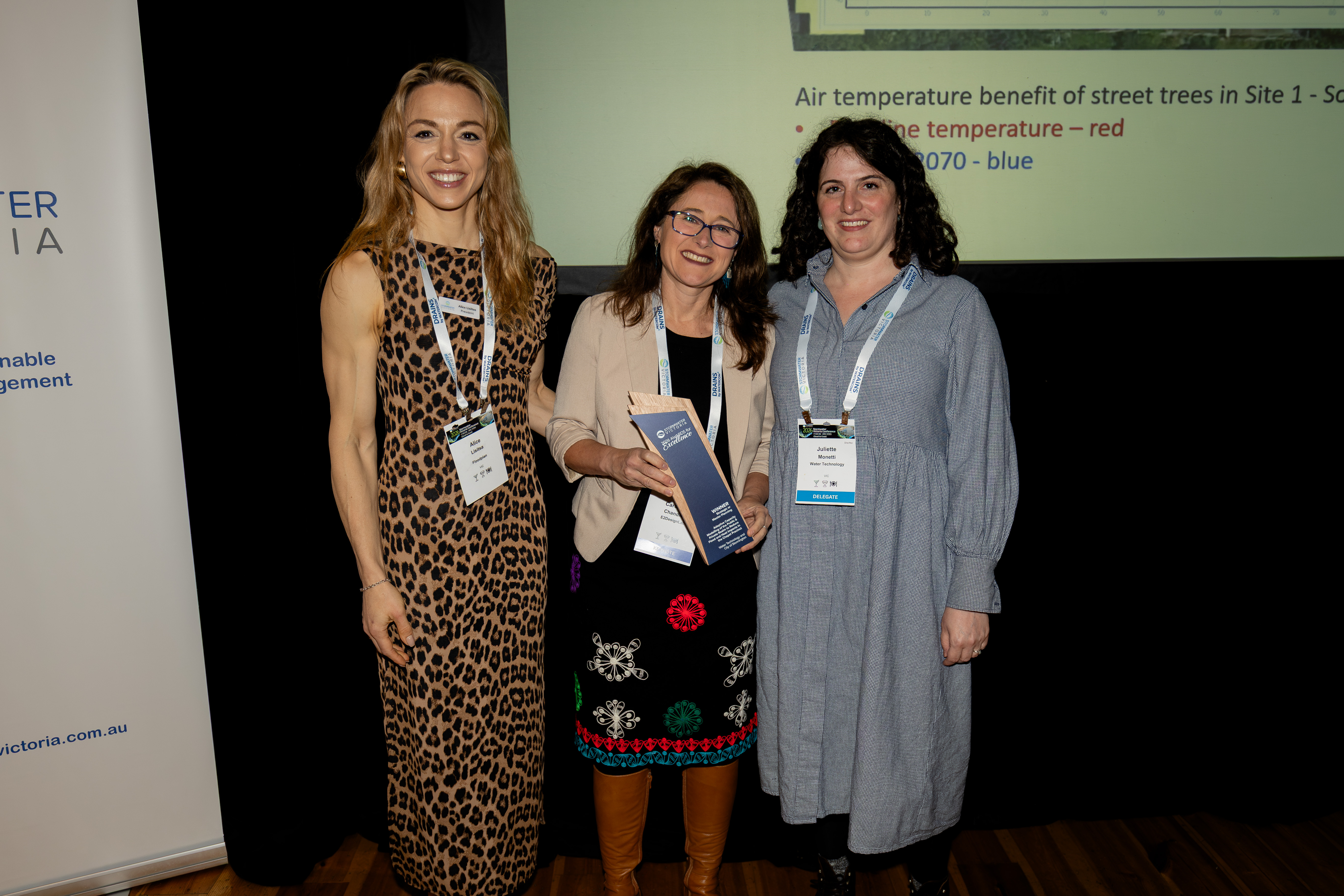
Adaptive capacity modelling of the public & private realm to reduce flood and heat impacts in the Chapel precinct
Water Technology
Project Overview: City of Stonnington’s Chapel Precinct is an important activity centre poised for significant development and renewal. A Climate Vulnerability Assessment undertaken by CSIRO identifies the precinct as vulnerable to the impacts of climate change, in particular increased urban heat and flooding by 2070.
This project supports the precinct planning process by providing evidence of benefits associated with two adaptation pathways to 2050 and 2070: a business as usual or cautious approach and an adaptive or radical approach. Building on internal engagement across council, comprehensive WSUD responses were developed for seven sites across the precinct, reflecting cautious and radical policy settings and best practice WSUD design practices. The CRC for Water Sensitive Cities Scenario Tool and TUFLOW were used to model changes in air and surface temperature, flood level differences and areas impacted by flooding. Site findings were then extrapolated and modelled for the precinct.
The results indicate that cautious pathways can only provide small reductions in flooding and heat, with the radical pathway being the most effective due to the larger number of WSUD assets to manage stormwater in the landscape. This further enforces the need for radical planning and policy settings to support a climate resilient and liveable precinct.
"A forward‑thinking project that looks beyond BAU and challenges current urban planning approaches by integrating innovative Integrated Water Management solutions to address climate change, urban heat island impacts and deliver long‑term community resilience".
Excellence in Infrastructure
Nominees
K Road Cliffs Masterplan Implementation Project – Engeny, Wyndham City Council and Urban Initiatives
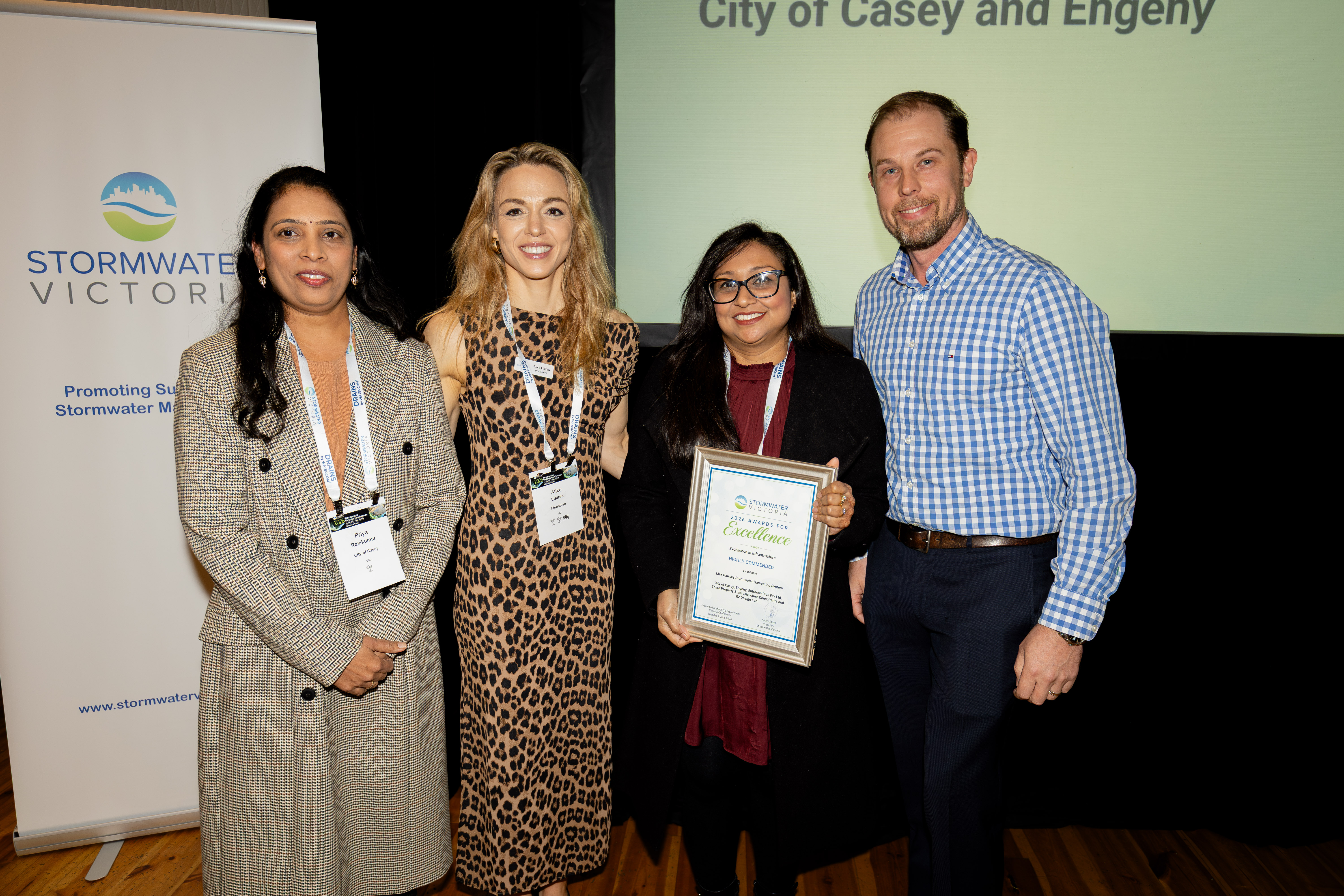
Max Pawsey Stormwater Harvesting System – City of Casey and Engeny - Highly Commended
Alira Waterways & Estate - Excellence in Infrastructure – KLM Spatial and Stormy Water Solutions
Reimagining Lewis Park Retarding Basin and Blind Creek – Alluvium Consulting, Knox City Council and Melbourne Water
Peter Hopper Lake Revitalisation – Spiire and City of Whittlesea
Excellence in Infrastructure
Winner
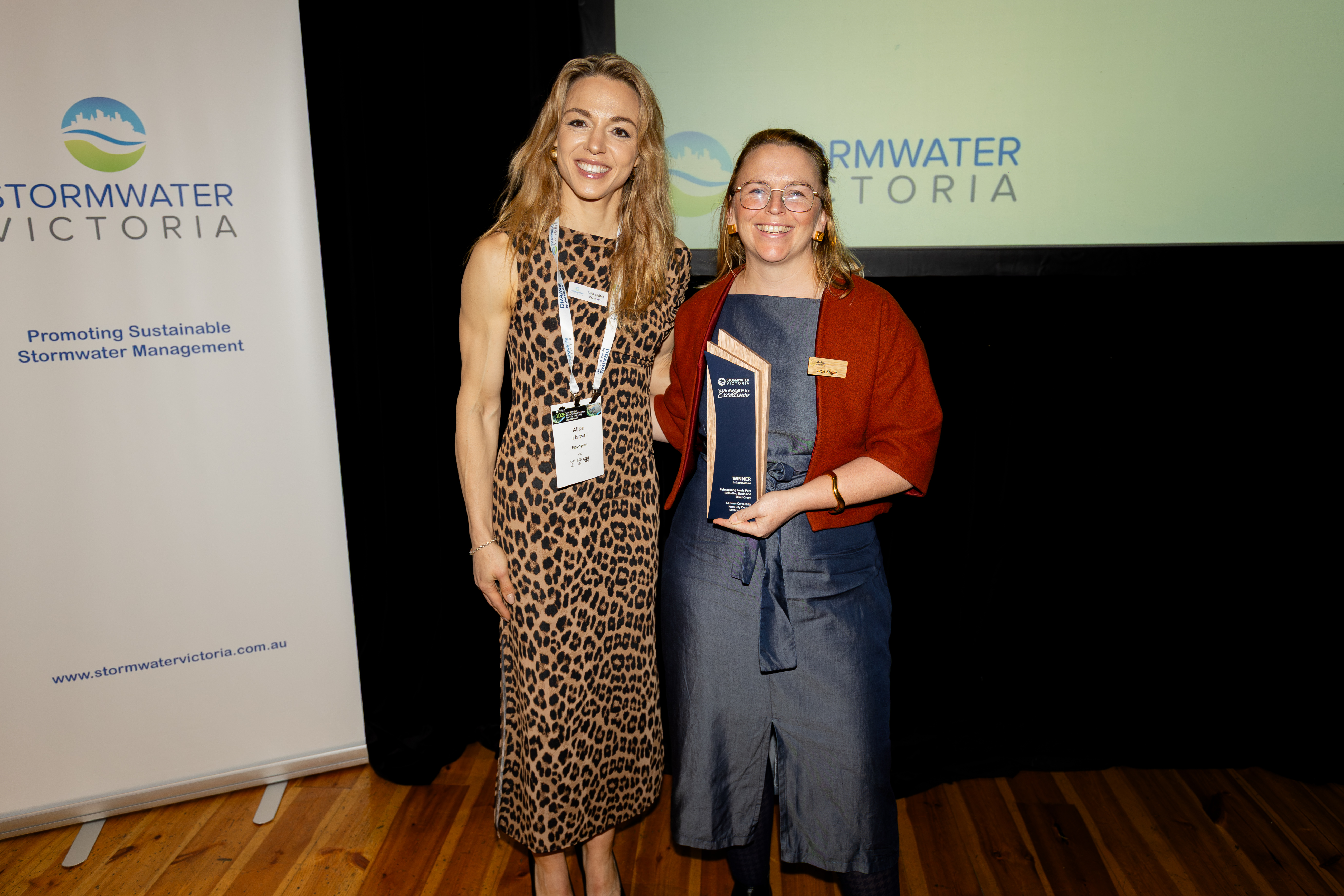
Reimagining Lewis Park Retarding Basin and Blind Creek
Alluvium Consulting, Knox City Council and Melbourne Water
Project Overview: The Reimagining Lewis Park Retarding Basin and Blind Creek project is a major open space and waterway transformation extending from Scoresby Road through to the Lewis Park Retarding Basin in Wantirna South. As Knox continues to grow and densify, the project was undertaken to improve stormwater quality, maintain flood protection, and reimagine under-utilised drainage infrastructure as a multifunctional green space for community, ecological and water management outcomes.
The project includes three constructed wetlands, two naturalised channel reaches, two stormwater harvesting ponds, extensive revegetation and a connected network of paths and community infrastructure. Key objectives were to improve stormwater quality entering Blind Creek, maintain existing hydraulic and flood conditions, increase community interaction with the waterway through creek daylighting, improve accessibility and connectivity to surrounding amenities, and enhance biodiversity, urban cooling and amenity.
Innovative urban and landscape design interventions were used to celebrate water in the landscape while retaining the core flood function of the retarding basin.
Construction is now completed and the site is a popular and well-utilised by the community.
"Melbourne Water’s recently constructed Reimagining Lewis Park Retarding Basin and Blind Creek project plays a pivotal role in delivering Knox City Council’s vision to transform 40 hectares of Lewis Park into the green heart of Knox.
Implemented at scale, the project blends engineered and natural assets, including daylighting former stormwater drainage pipes, creating new wetlands, and installing stormwater harvesting infrastructure that will help diversify the City’s water supply into the future. More than half a million plants were established, complemented by new community infrastructure that makes the precinct a vibrant destination for residents and visitors alike.
The broader benefits of this project are significant, addressing issues such as flooding, habitat restoration, community connectivity, water quality improvement, stormwater harvesting and traditional owner values, backed by meaningful engagement. In summary, this outstanding project not only gives back to community but also creates a local destination that fosters community wellbeing and environmental sustainability".
Young Stormwater Professional of the Year
Nominees
Merlin Jolly - Arup
Samuel Beckham - Stantec
Kirsten Fearn-Wannan - Spiire
James Trebilco - Beca
Young Stormwater Professional of the Year
Winner
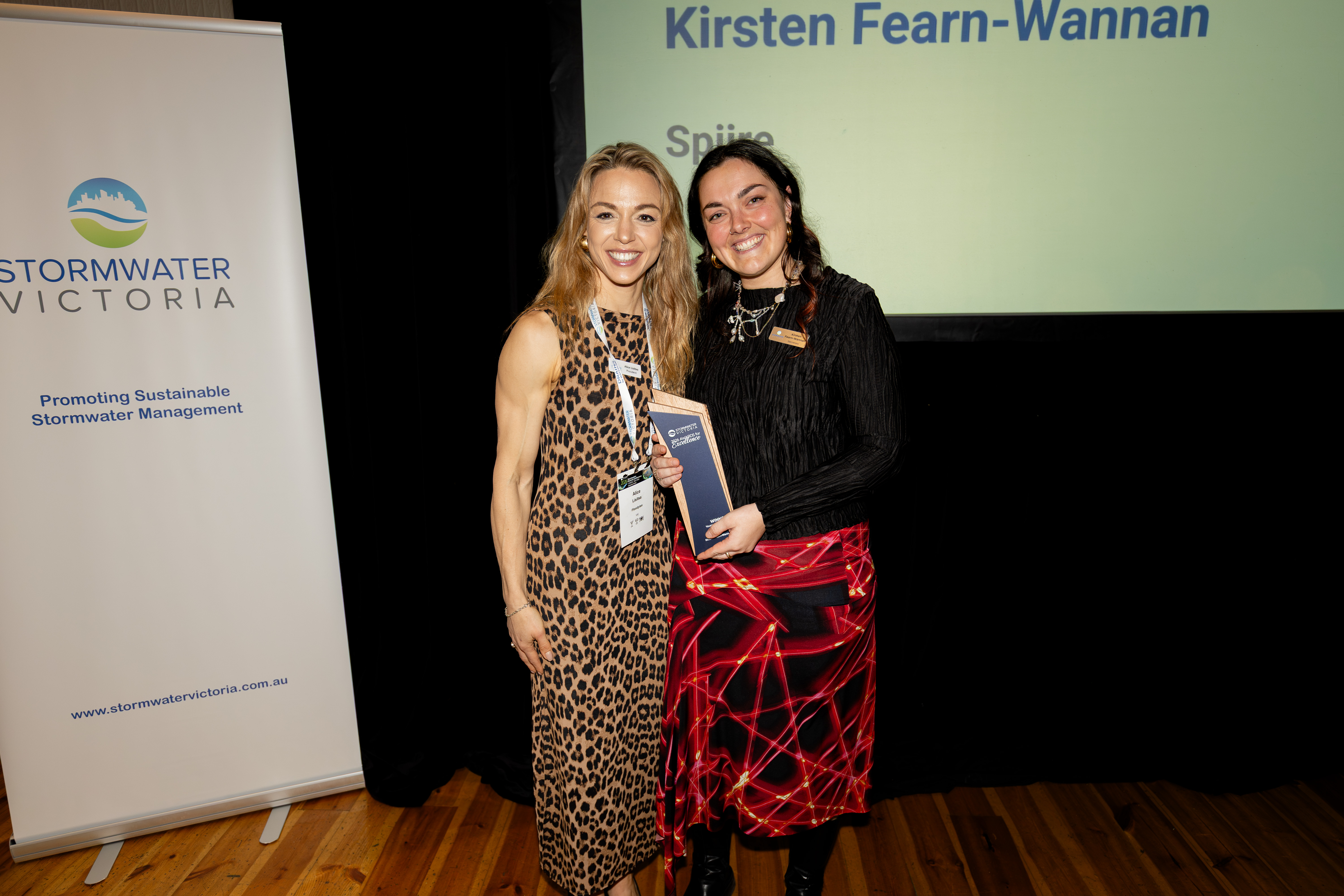
Kirsten Fearn-Wannan - Spiire
Kirsten Fearn-Wannan is a civil engineer with five year experience delivering Multidisciplinary Civil road and drainage along with WSUD and stormwater projects across Australia. Graduating in May 2021 from Monash University, Kirsten has always had a strong interest in IWM and design. Undertaking Spiires student and graduate program in our Civil team gave her a fantastic grounding in fundamentals problem solving principles. Kirsten actively pursued her passion for problem solving and design outcomes in the Water space transitioning into Spiires integrated water team in 2023. Kirsten specialises in the design and construction supervision of waterways, wetlands, and bioretention systems with a strong focus on quality, sustainability and community outcomes. A collaborative team member demonstrating strong leadership and mentoring capabilities and systematic improvements across design and QA processes. An invaluable team member who leads by example and supports other with their own goals. I cannot recommend her more highly for this award.
"Kirsten demonstrates a balance between technical problem solving, teamwork and actively participating in wider industry events. As a young professional, Kirsten’s enthusiasm and passion for the stormwater industry makes her an excellent role model for all stormwater professionals".
 2024 Stormwater Victoria Awards
Congratulations to the winners of the 2024 Awards for Excellence
The Awards Ceremony took place at Silverwater Resort, San Remo on Tuesday, 4th June 2024 with over 200 people in attendance to watch us recognise so many amazing water projects from across the industry this year. See below full list of winners:
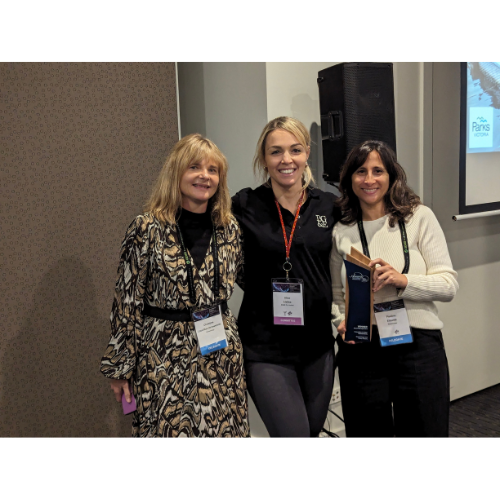
Excellence in Asset Management - Winner
A Little Litter Goes a Long Way: Innovation in Litter Assessments
Streamology and Parks Victoria
Project Overview: Parks Victoria has actively managed litter in the Yarra and Maribyrnong Rivers for 20+ years. Recent funding from the Commonwealth Government is enabling the review of existing practices and implementation of new infrastructure and capture methods. Streamology undertook an innovative data-based study for Parks Victoria, that focussed on assessing the typical operational hydrodynamic conditions, the performance of currently used and alternative litter trap designs and locations to optimise the management of litter in both waterways.
The study, conducted over three stages, showed that litter trap location within the waterways was a key determinant of success and relocating existing traps can significantly increase performance. In general, the effectiveness and feasibility of different litter interceptors was related to the type of litter the device targets (e.g. small, medium or large) and where they can be placed (e.g. whether they require access roads, power connection or land owned by others).
A comparison of options scenarios using different combinations of litter interceptors showed how litter management requires an integrated approach, combined with knowledge of the targeted litter types, sources and pathways.
"The project is impactful in that it will lead to significantly improved litter trap design, program planning and operational management - substantially increasing litter loads captured and improving efficiency of asset maintenance. The project considers multiple environmental, economic and social benefits in its MCA and cleverly combines hydrodynamic modelling, smart technology and field-based observation to provide (and validate) a better understanding of litter transport. Findings have already been integrated into project planning and operations, with significant improvements realised, and will be further implemented over coming months and years (subject in part to budget considerations). Collaboration is very good, including engaging with litter trap manufacturers as well as the expected internal discussions. It is also proposed to share findings with the broader industry so these can be used in other jurisdictions. All up, a well-designed and impressive study that will have significant benefits for litter capture in the lower Yarra and Maribyrnong Rivers."
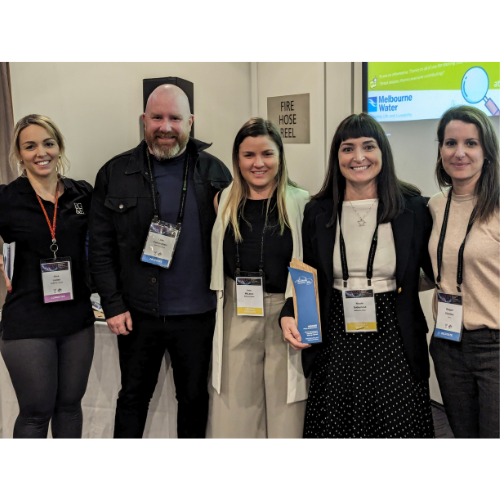
Excellence in Policy and Education - Winner
Flood management capacity building training program
Rain Consulting and Melbourne Water
Project Overview: To deliver on actions of the Flood Management Strategy, this project aimed to design and deliver a targeted training program to build capacity of Council staff across Melbourne Water's management region. The purpose of the sessions were to ensure councils and stakeholders feel more informed on technical flood information to help Melbourne Water and Councils to work together to address and respond to the flood challenges across the region. The key outcomes of the program were:
- Participants feel they have improved their level of knowledge and increased their confident level to use new approaches or practices in your work
- Participants can apply learnings from the program in a practical way
- Participants are equipped with best practice concepts and tools to apply.
Five sessions in the format of a 1 hour presentation with a tutorial or guest speaker session afterwards were designed and presented. Four of the presentations were given live with 278 attendees across the sessions. All sessions, including the fifth recorded session, were made available online as recordings to all councils. Guest speakers were Melbourne Water or Council staff members with expertise in their fields.
Very positive feedback from attendees were recorded for all sessions.
"This is a well-designed and executed capacity building project that met industry knowledge needs through its customised format, implementing a key priority for Melbourne Water's Flood Strategy. The online availability of these knowledge sharing products for future use is a great outcome, and the phase 2 rollout in 2024 is a strong demonstration of project success and value."
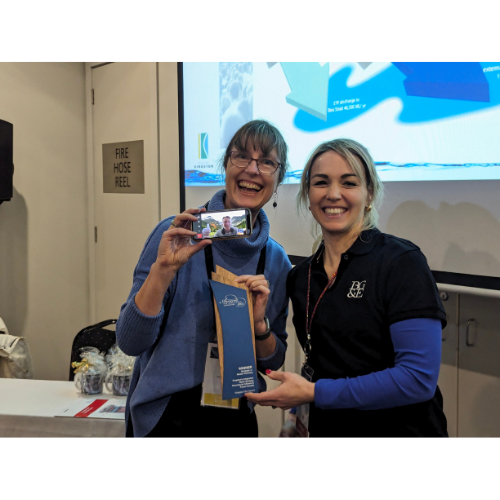
Excellence in Strategic or Master Planning - Winner
Kingston's Integrated Water Strategy - Planning for Climate & Future Growth
Kingston City Council
Project Overview: Drawing on 20 years of successfully implementing integrated water management (IWM)initiatives, the City of Kingston’s latest Strategy has created a shared vision to address future challenges, including forecast climate change and increasing residential development.
- Using less drinking water and increasing the use of alternatives, such as rainwater tanks, stormwater and recycled water;
- Protecting waterways and Bay from all forms of pollution;
- Improving flood management;and
- Enhancing education and partnerships with our community.
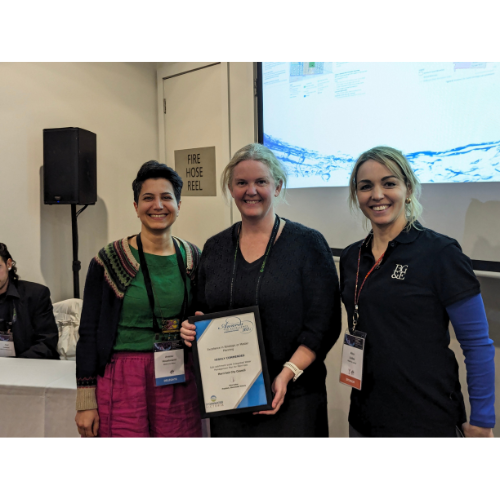
Excellence in Strategic or Master Planning - Highly Commended
Sub-catchment-scale Integrated Water Management Plan for Merri-bek
Merri-bek City Council and Melbourne Water
Excellence in Integrated Stormwater Design - Winner
Murrk Ngubtj Yarram Yaluk (formerly Bellarine Basin) Transformation
Spiire and Barwon Water
Project Overview: Spiire designed the realignment and rehabilitation of Yarram Creek at the former site of the Bellarine Basin, now known as Murrk Ngubitj Yarram Yaluk.
The creek was connected back to its original course as the first phase of a wider Barwon Water initiative to transform the former Basin site into more than 30 hectares of environmental and public open space.
Spiire’s design was driven by the challenge of restoring natural habitat and enhancing biodiversity values into the future. One of the site’s new features is an ephemeral lake, which provides a habitat for native species such as the black swan and restores downstream flow into Yarram Creek.
Its design was informed by an ecological assessment and water balance modelling to ensure it delivers optimal water health and habitat.
"This nomination highlights how projects can be designed to suit a purpose and budget. Allowing the system to "find its own" natural state, using what is on site already is exemplary and something we should all consider."
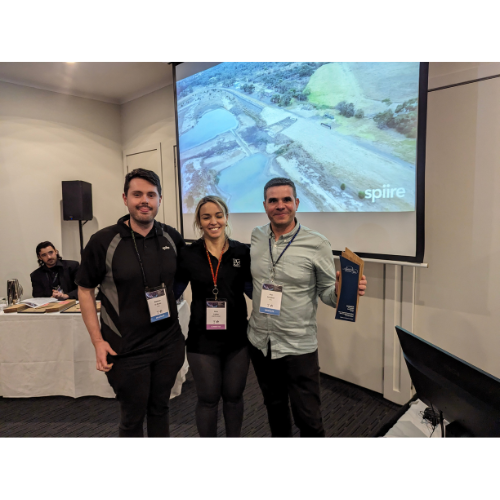
Excellence in Research and Innovation - Winner
MUSICX automation and optimisation to test harvesting targets across Melbourne
ARUP and Department of Energy, Environment and Climate Action
Project Overview: As Victoria’s population grows, so does the number of dwellings, roads and supporting commercial development required. Over time, the urban footprint of Melbourne has been expanding to accommodate this growing population. This has resulted in an increase in imperviousness and stormwater runoff that ultimately degrades our waterways and waterbodies. To tackle this challenge, Arup worked with DEECA and Frontier Economics to identity effective treatment train interventions across different development scenarios and rainfall bands within Metropolitan Melbourne. The original brief and proposal accounted for 10 development scenarios to be tested using MUSICX, however Arup found this would not adequately cover the range of possibilities - with variations in development types (residential, industrial, commercial, extensions, infill etc at various scales), and in different locations with different rainfall, waterway conditions and stormwater management possibilities. Recognising the limitations and 'blind spots' this created in identifying effective interventions, the Arup digital team developed a method to take an automation and optimisation approach using Artificial Intelligence (A.I). This method enabled Arup to execute and evaluate 24,500 MUSIC X model runs and resulted in a robust database for determining the best optimal WSUD combination for a variety of scenarios.
"There is a lack of knowledge in industry on if and how various types of development can achieve the proposed flow reduction targets recently published by EPA. This work applies robust methodology to fill this gap and provides valuable insights to inform policy making within Greater Melbourne."
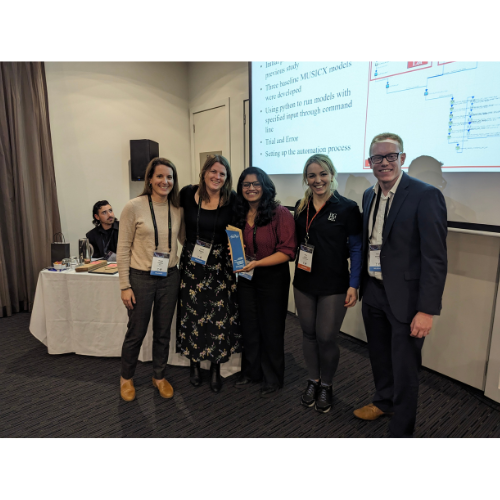
Excellence in Research and Innovation - Highly Commended
JohnConnorOnline: Online WSUD Modelling, Reporting & Compliance Tool
Cleanstormwater
2022 Stormwater Victoria Award Winners
Congratulations to the winners of the 2022 Awards for Excellence
The Awards Ceremony took place at Novotel Geelong on Tuesday, 7th June 2022 with over 100 people in attendance to watch us share the stage with AWA and recognise so many amazing water projects from across the industry this year. See below full list of winners:
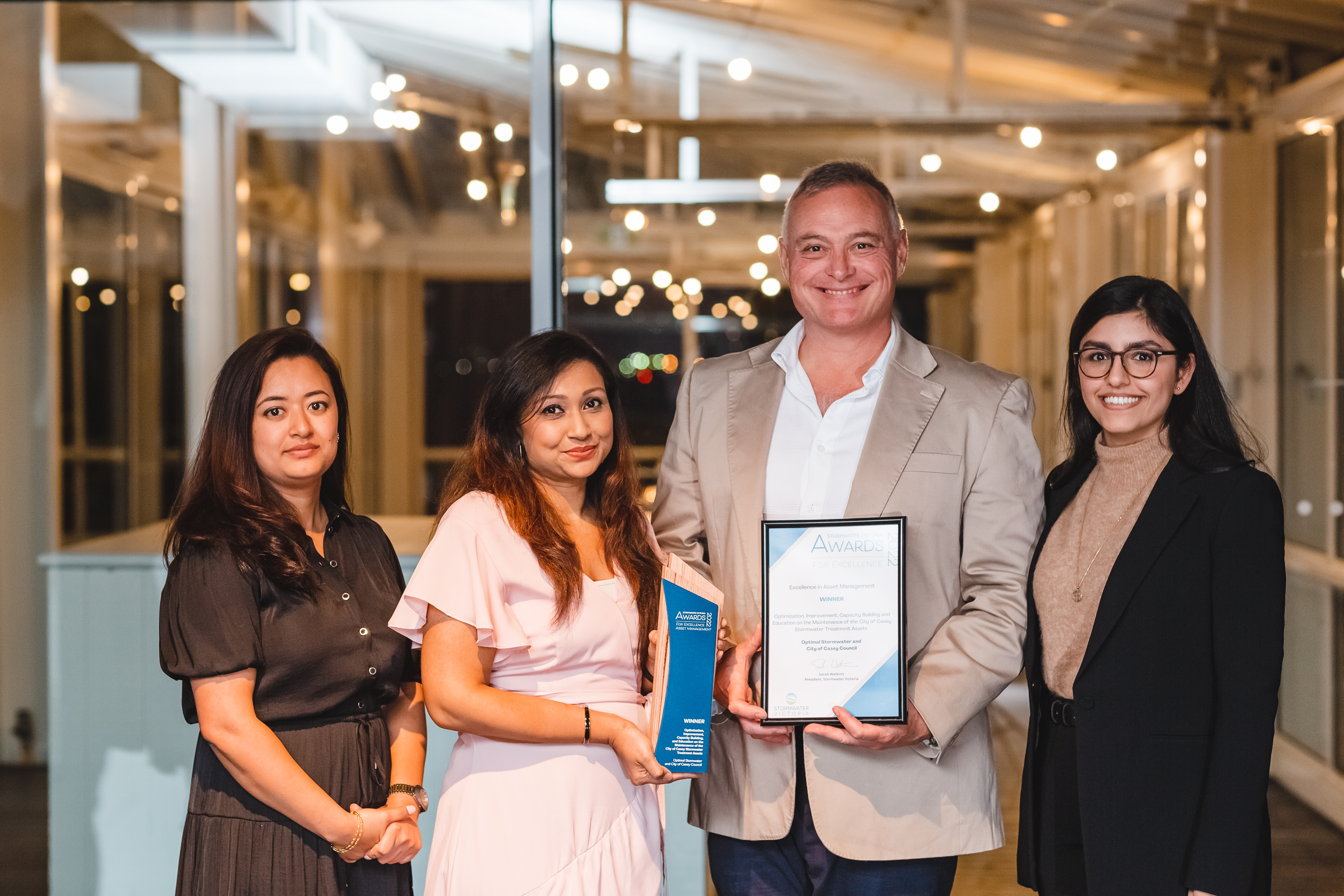
Excellence in Asset Management - Winner
Optimization, Improvement, Capacity Building and Education on the Maintenance of the City of Casey Stormwater Treatment Assets
Optimal Stormwater and City of Casey Council
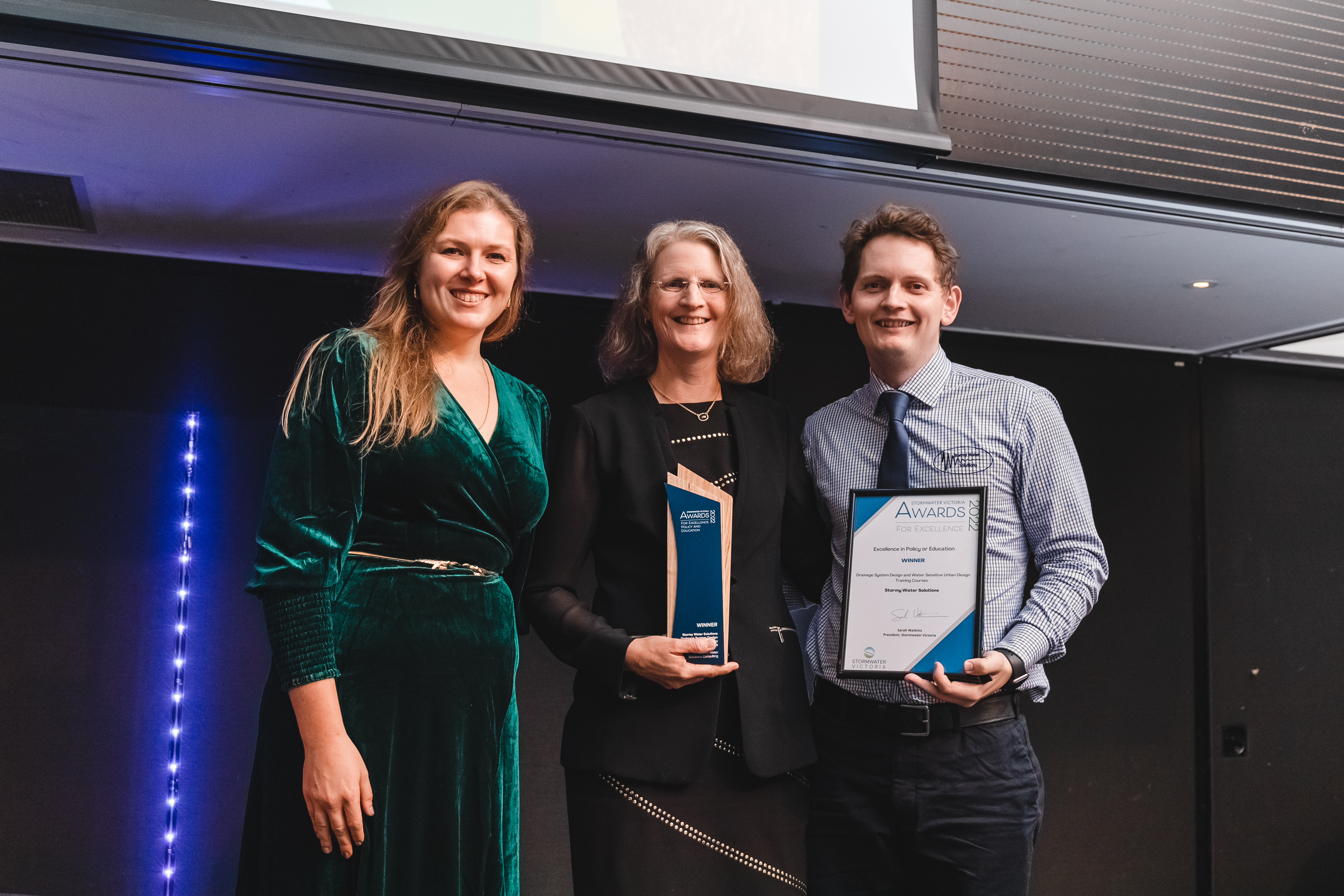
Excellence in Policy or Education - Winner
Drainage System Design and Water Sensitive Urban Design Training Courses
Stormy Water Solutions
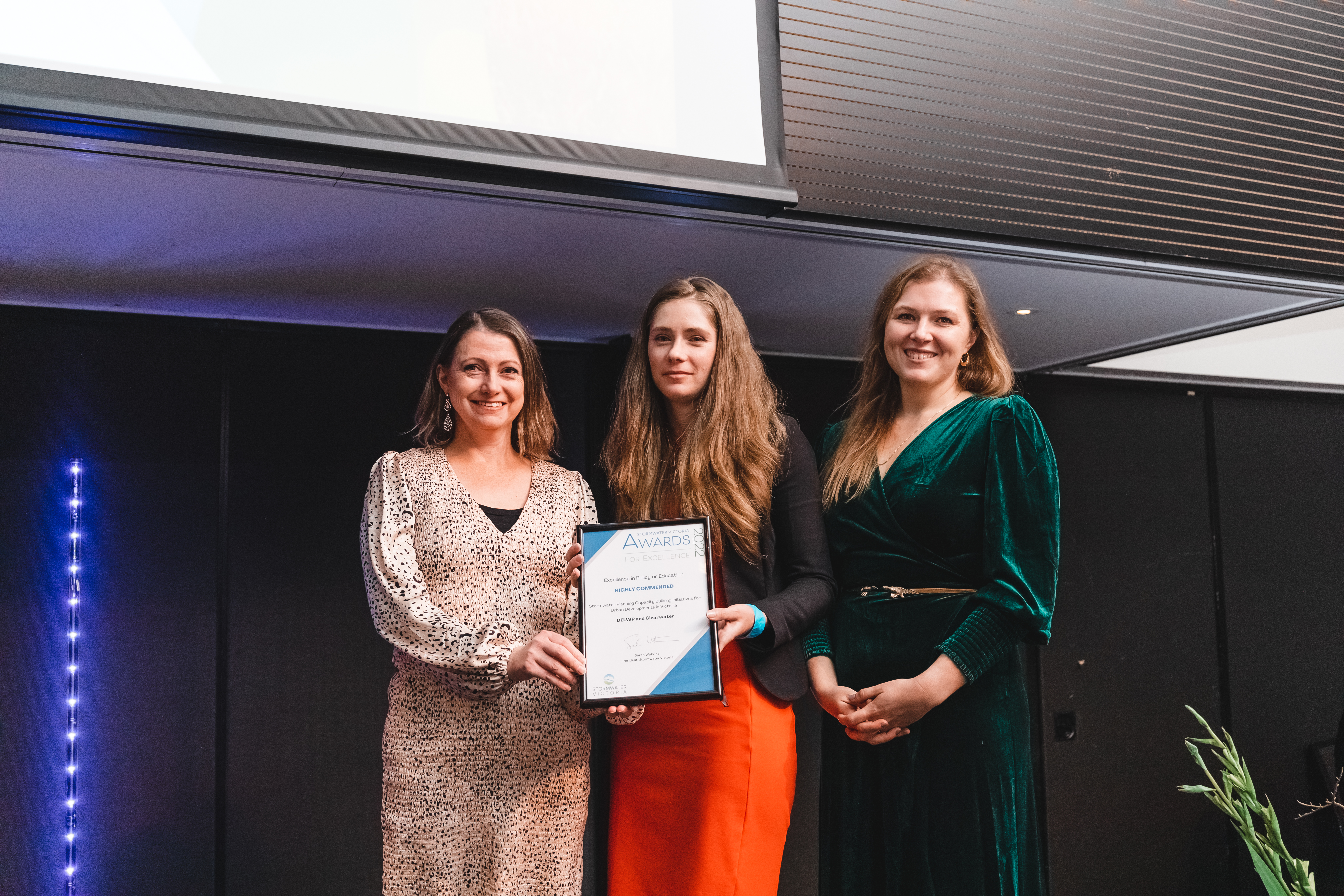
Excellence in Policy or Education - Higly Commended
Stormwater Planning Capacity Building Initiatives for Urban Developments in Victoria
DELWP and Clearwater
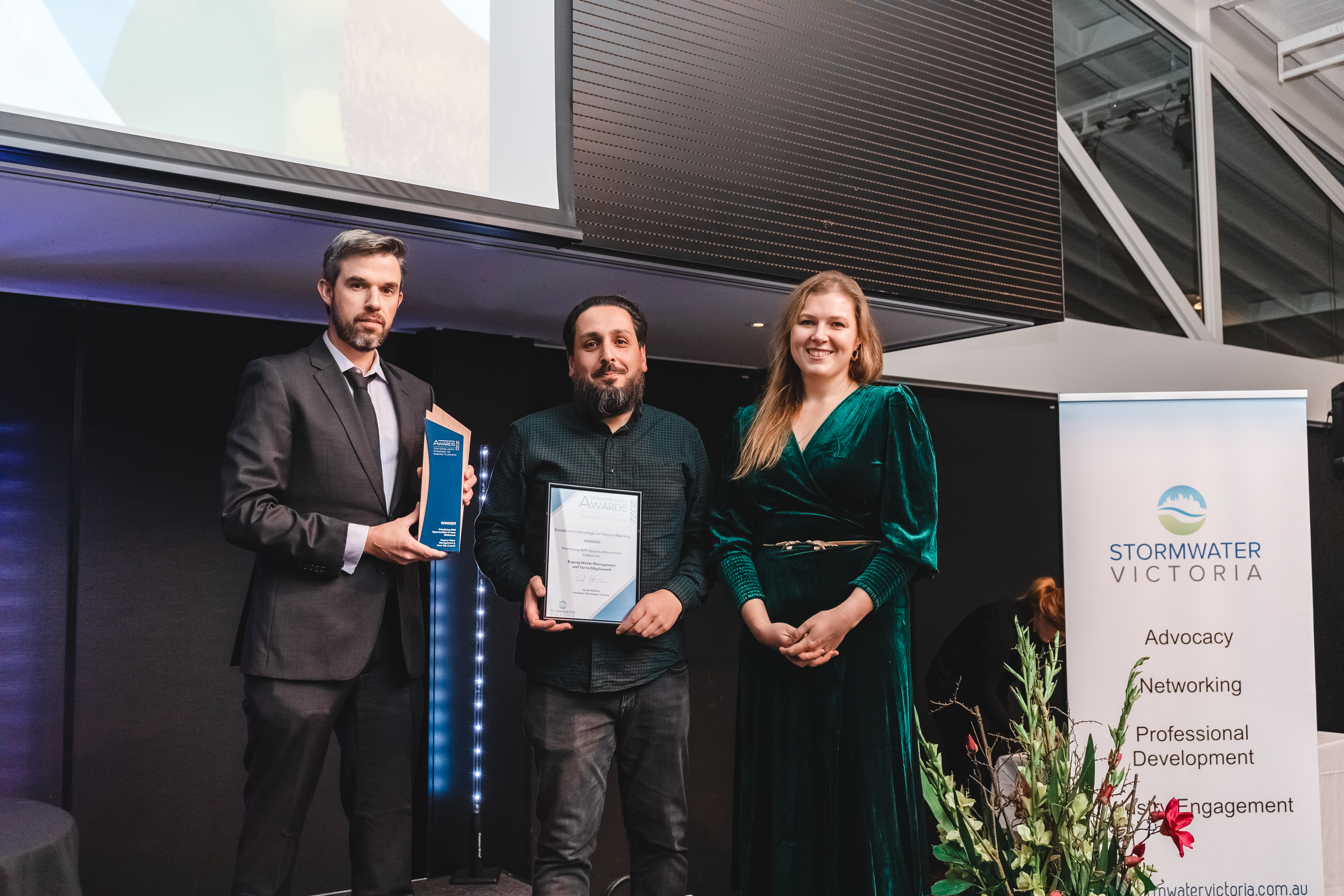
Excellence in Strategic or Master Planning - Winner
Prioritising IWM Opportunities in Inner Melbourne
Engeny Water Management and Yarra City Council
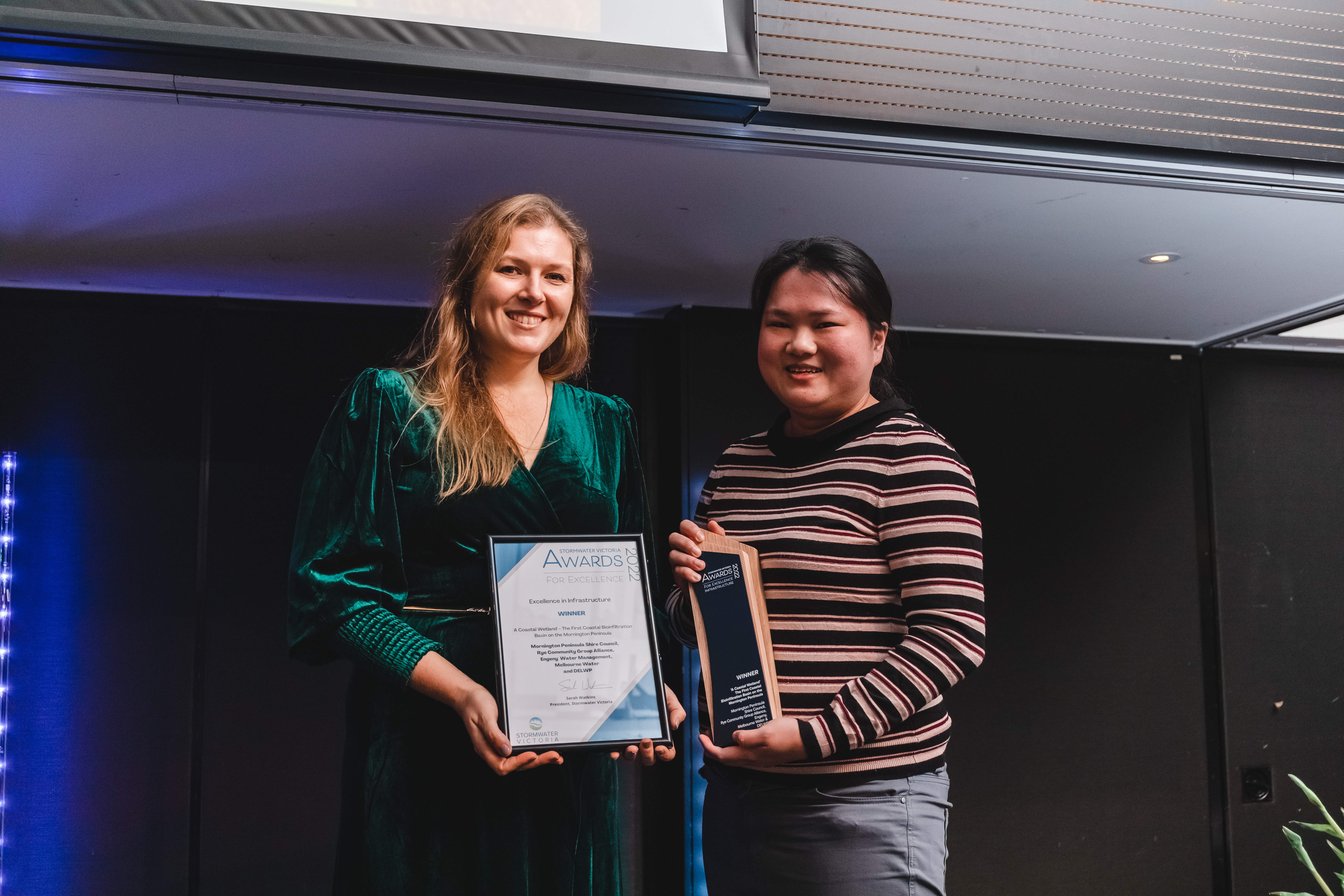
Excellence in Infrastructire - Winner
'A Coastal Wetland' - The First Coastal Bioinfiltration Basin on the Mornington Peninsula
Mornington Peninsula Shire Council, Rye Community Group Alliance, Engeny Water Management, Melbourne Water and DELWP
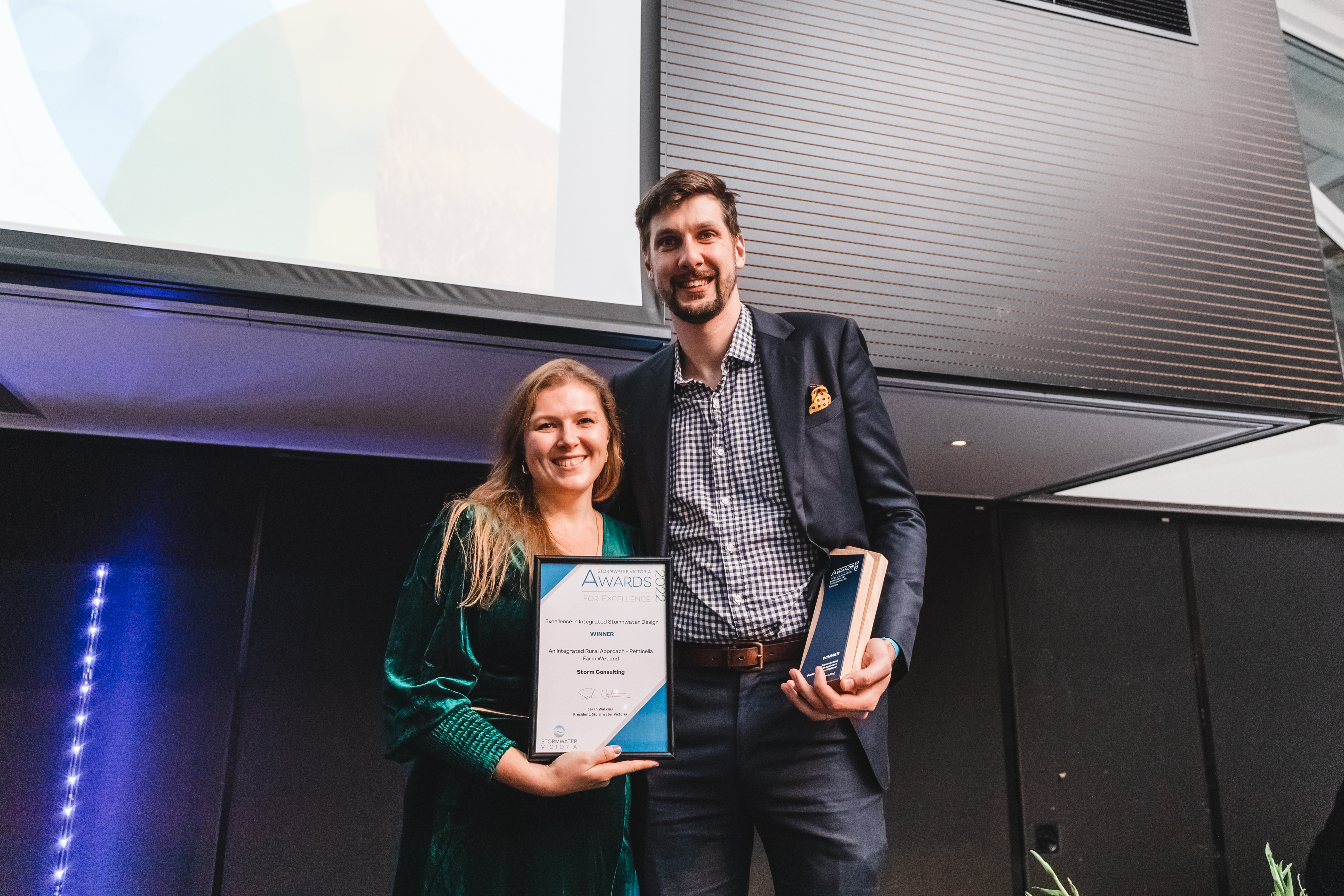
Excellence in Integrated Stormwater Design - Winner
An Integrated Rural Approach - Pettinella Farm Wetland
Storm Consulting
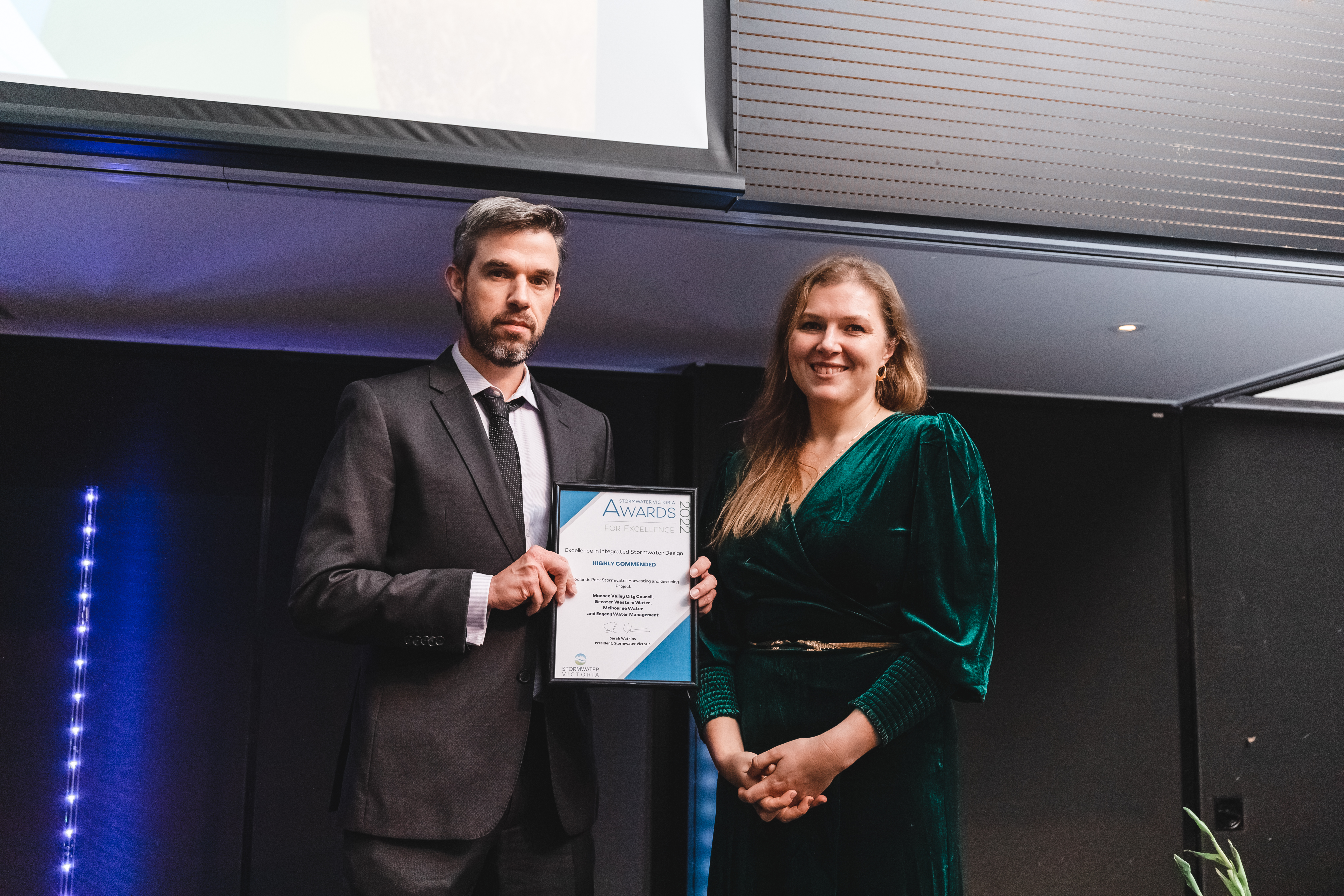
Excellence in Integrated Stormwater Design - Highly Commended
Woodlands Park Stormwater Harvesting and Greening Project
Moonee Valley City Council, Greater Western Water, Melbourne Water and Engeny Water Management
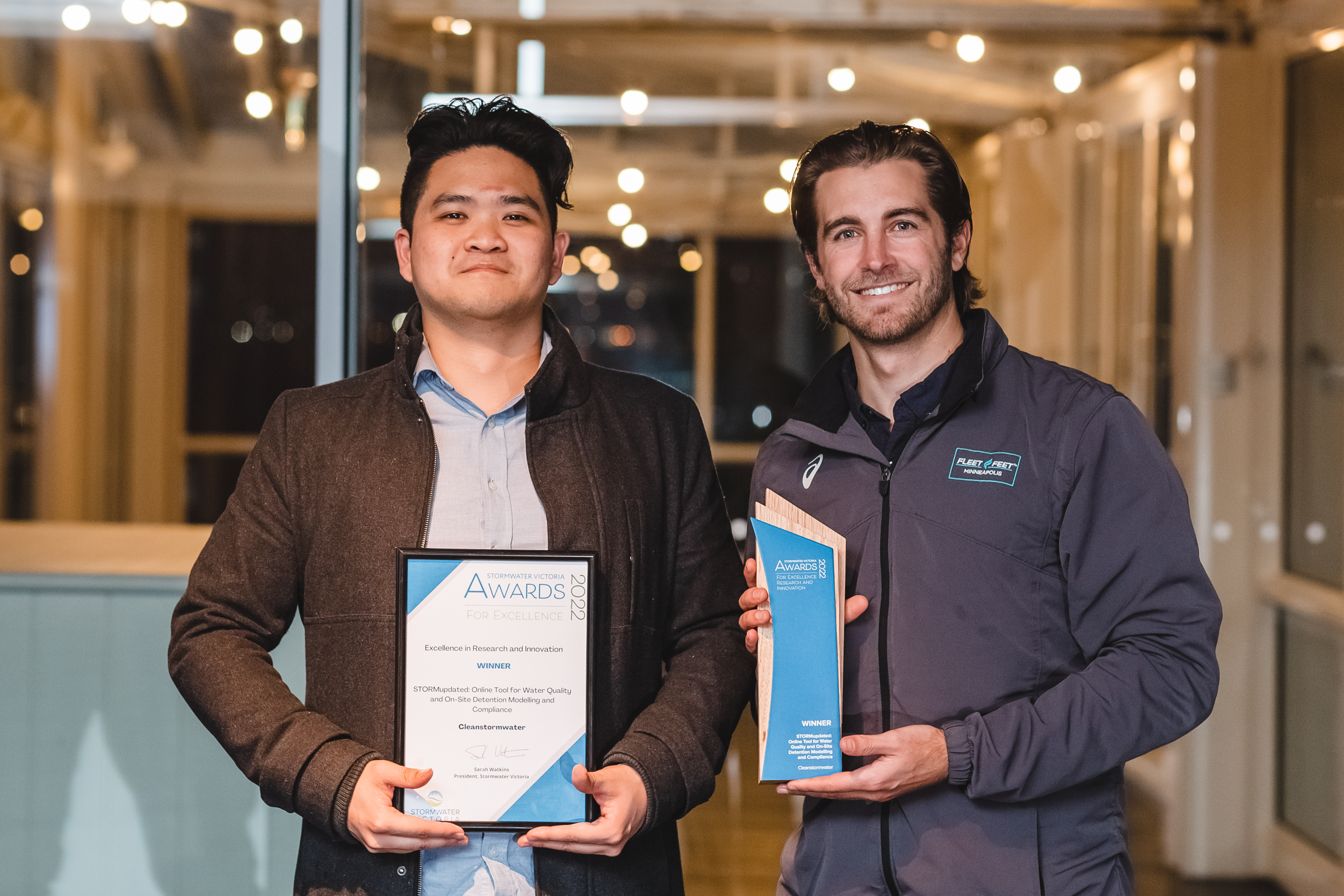
Excellence in Research and Innovation - Winner
STORMupdated: Online Tool for Water Quality and On-Site Detention Modelling and Compliance
Cleanstormwater
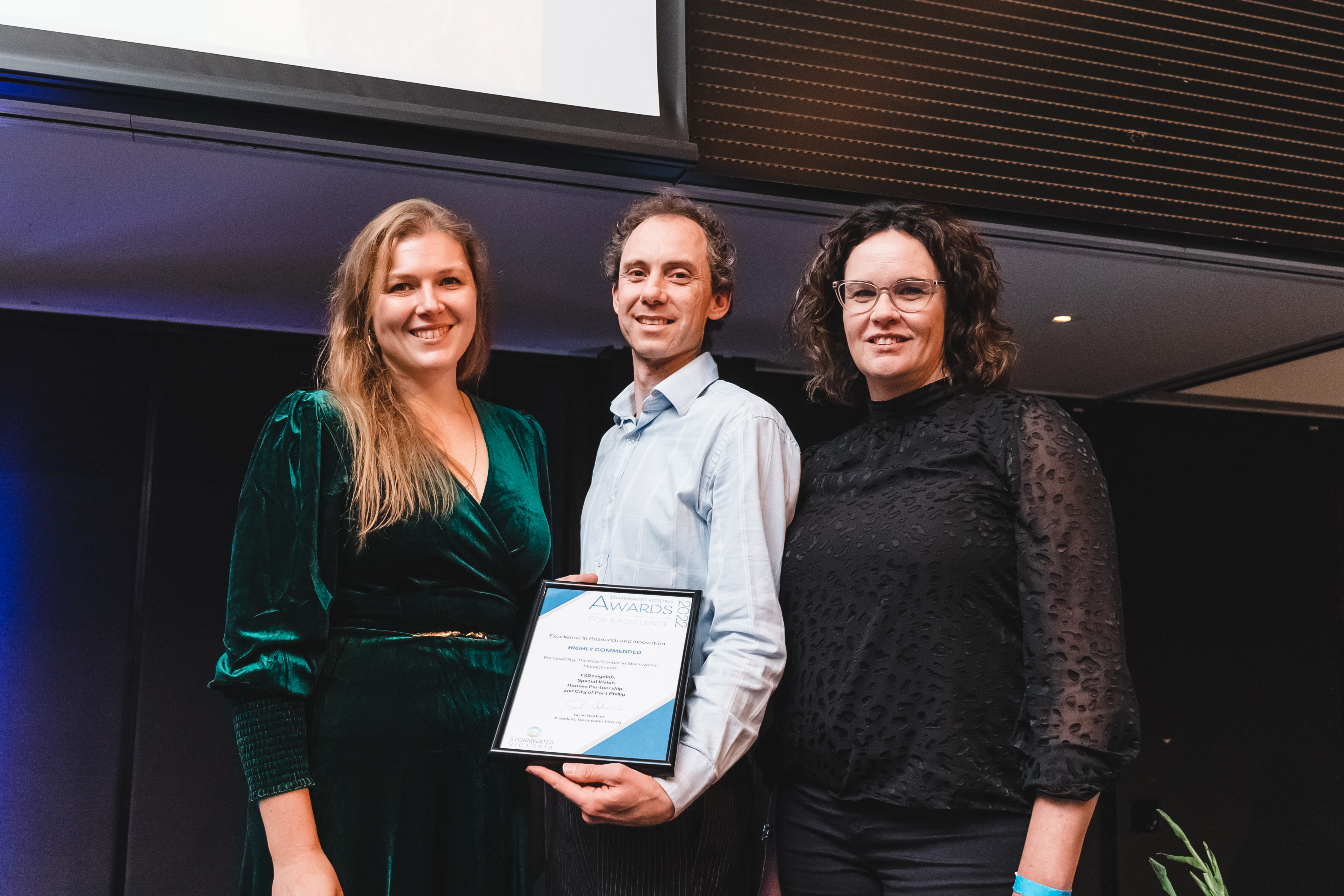
Excellence in Research and Innovation - Highly Commended
Permeability, The New Frontier in Stormwater Management
E2Designlab, Spatial Vision, Hansen Partnership and City of Port Phillip
2019 Stormwater Victoria Award Winners
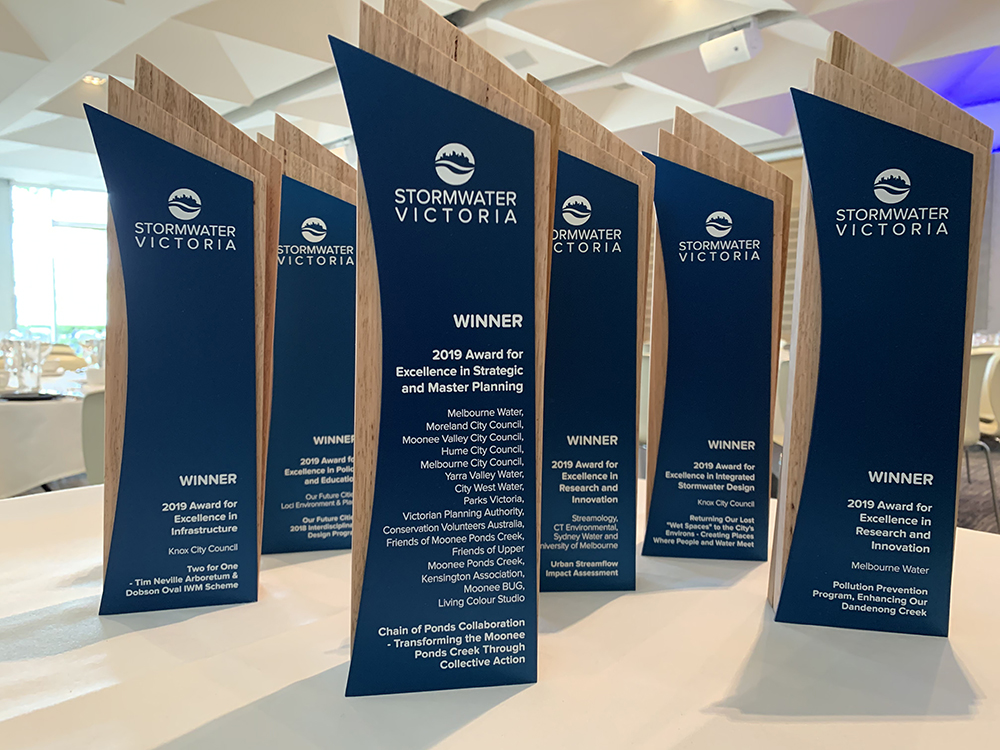
Stormwater Victoria would like to congradulate the winners of the 2019 Stormwater Victoria Awards for Excellence.
The Awards Ceremony took place at ZINC Federation Square on Thursday, 5th December 2019 with over 350 people in attendance to watch us share the stage with AWA and recognise so many amazing water projects from across the industry this year. See below full list of winners:
Excellence in Infrastructure
Highly Commended - Daylighting Dandenong Creek, Melbourne Water
Winner - Two for One - Tim Neville Arboretum & Dobson Oval IWM Scheme, Knox City Council
Excellence in Integrated Stormwater Design
Highly Commended - Alma Park Stormwater Harvesting System, City of Port Phillip, E2 DesignLab, Simpson Construction, Melbourne Water
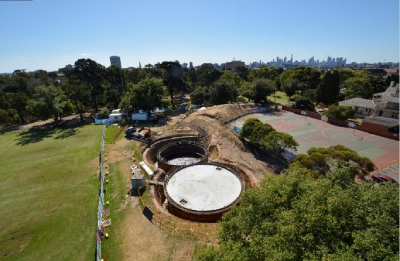
Winner - Returning Our Lost "Wet Spaces" to the City's Environs - Creating Places Where People and Water Meet, Knox City Council
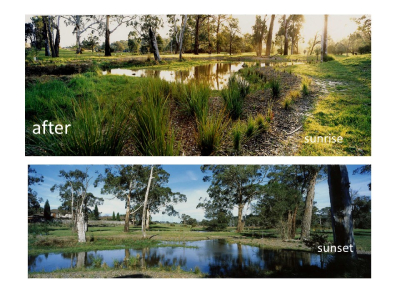
Excellence in Policy and Education
Winner - Our Future Cities: 2018 Interdisciplinary Design program, Our Future Cities, Loci Environment & Place
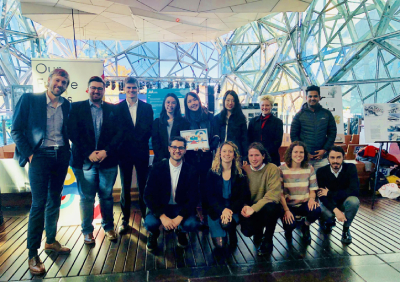
Excellence in Research and Innovation
Winner - Pollution Prevention Program, Enhancing Our Dandenong Creek, Melbourne Water
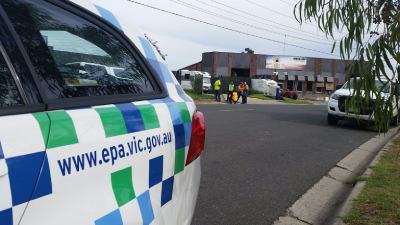
Winner - Urban Streamflow Impact Assessment (USIA), Streamology Pty Ltd, CT Environmental, Sydney Water, University of Melbourne
Excellence in Strategic and Master Planning
Winner - Chain of Ponds Collaboration - Transforming the Moonee Ponds Creek Through Collective Action, Melbourne Water, Moreland City Council, Moonee Valley City Council, Hume City Council, Melbourne City Council, Yarra Valley Water, City West Water, Parks Victoria, Victorian Planning Authority, Conservation Volunteers Australia, Friends of Moonee Ponds Creek, Friends of Upper Moonee Ponds Creek, Kensington Association, Moonee BUG, Living Colour Studio
If you have any questions regarding the Awards for Excellence, Media Releases or would like to obtain photos from the luncheon, please email Stormwater Victoria at officestormwatervictoria.com.au.